1st Place, Health Track, Garuda Hacks 7.0
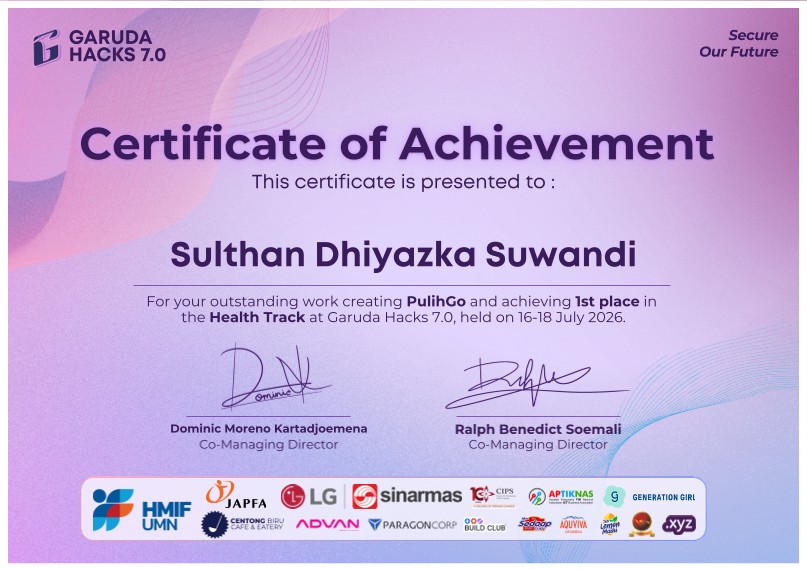
Won the Health Track with PulihGo, an offline-first mobile app for stroke rehabilitation.
 Award
Problem
Recovering an arm after a stroke takes hundreds of repetitions, and the brain rewires fastest in roughly the first three months. A typical outpatient session delivers only about 12 purposeful arm movements in 36 minutes. Home practice is meant to fill the gap, but it is boring, gives no feedback, and nobody can see whether it happened.
Idea
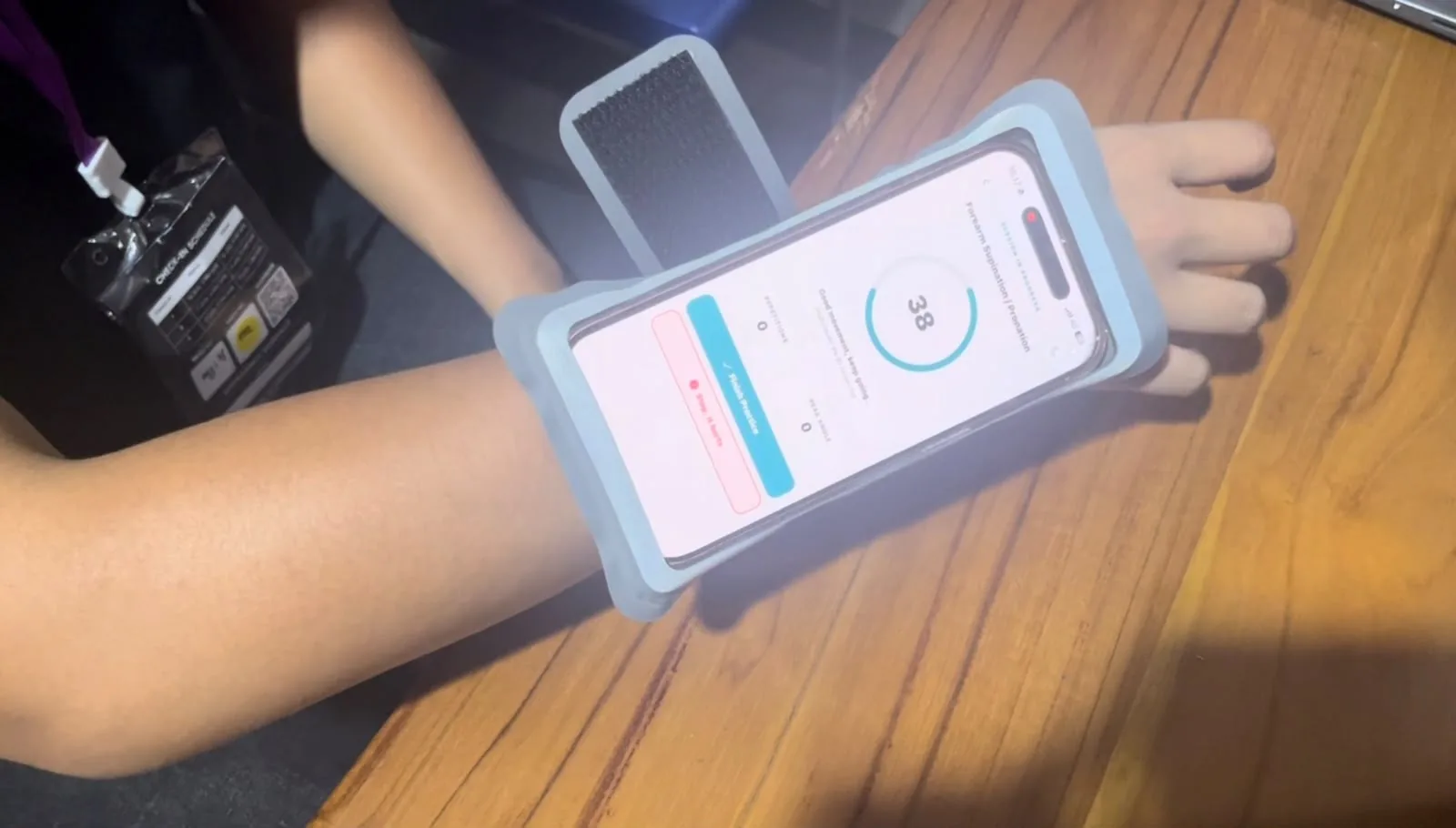
PulihGo turns the phone the patient already owns into a range-of-motion sensor: strap it to the forearm and the gyroscope measures how far the arm rotates, in degrees. Rehab exercises are rotational, and rotation is angular velocity, which the gyroscope measures directly and the accelerometer barely sees. No extra hardware is needed. The app measures, the therapist prescribes, the patient practises.
How it works
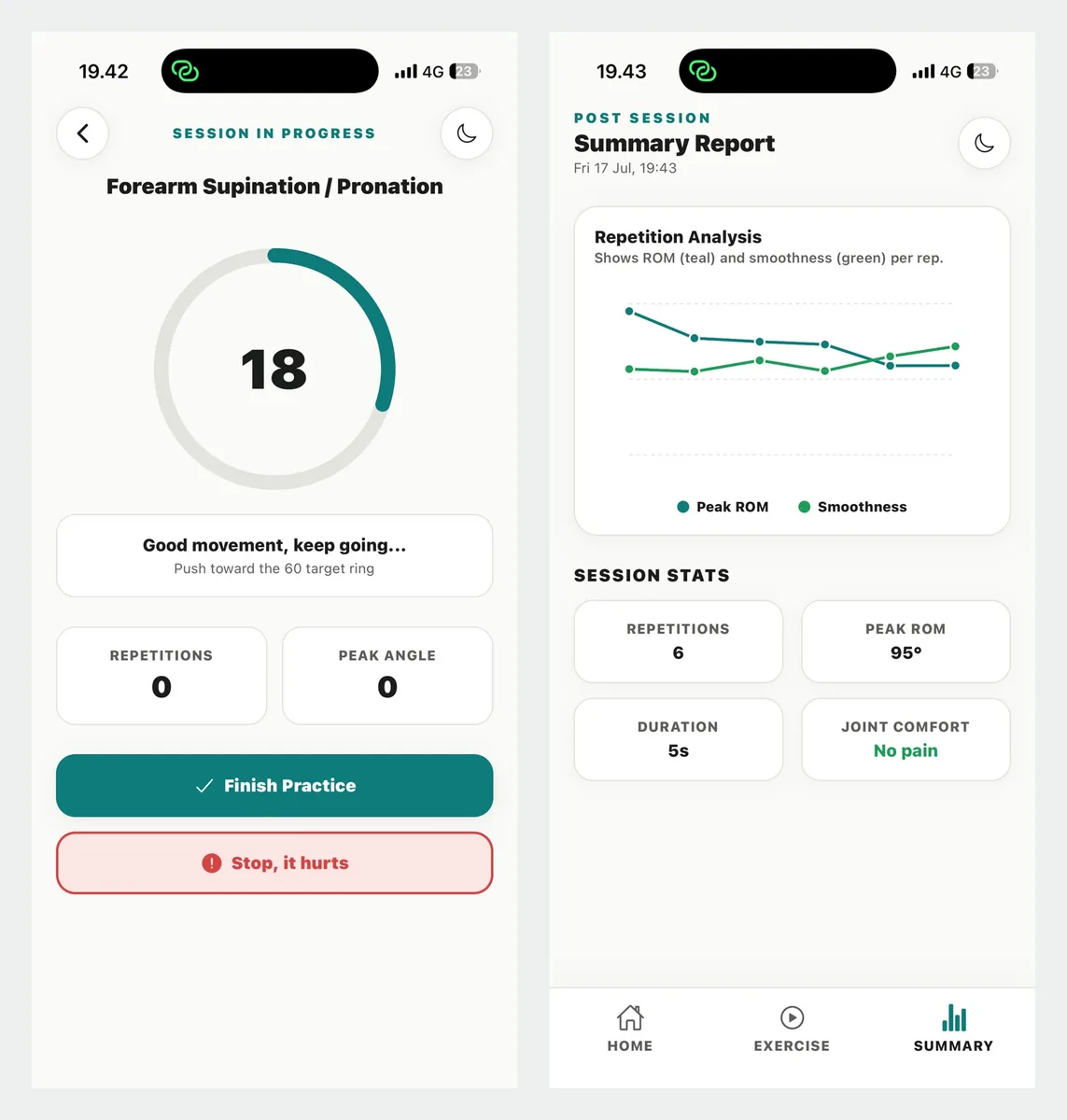
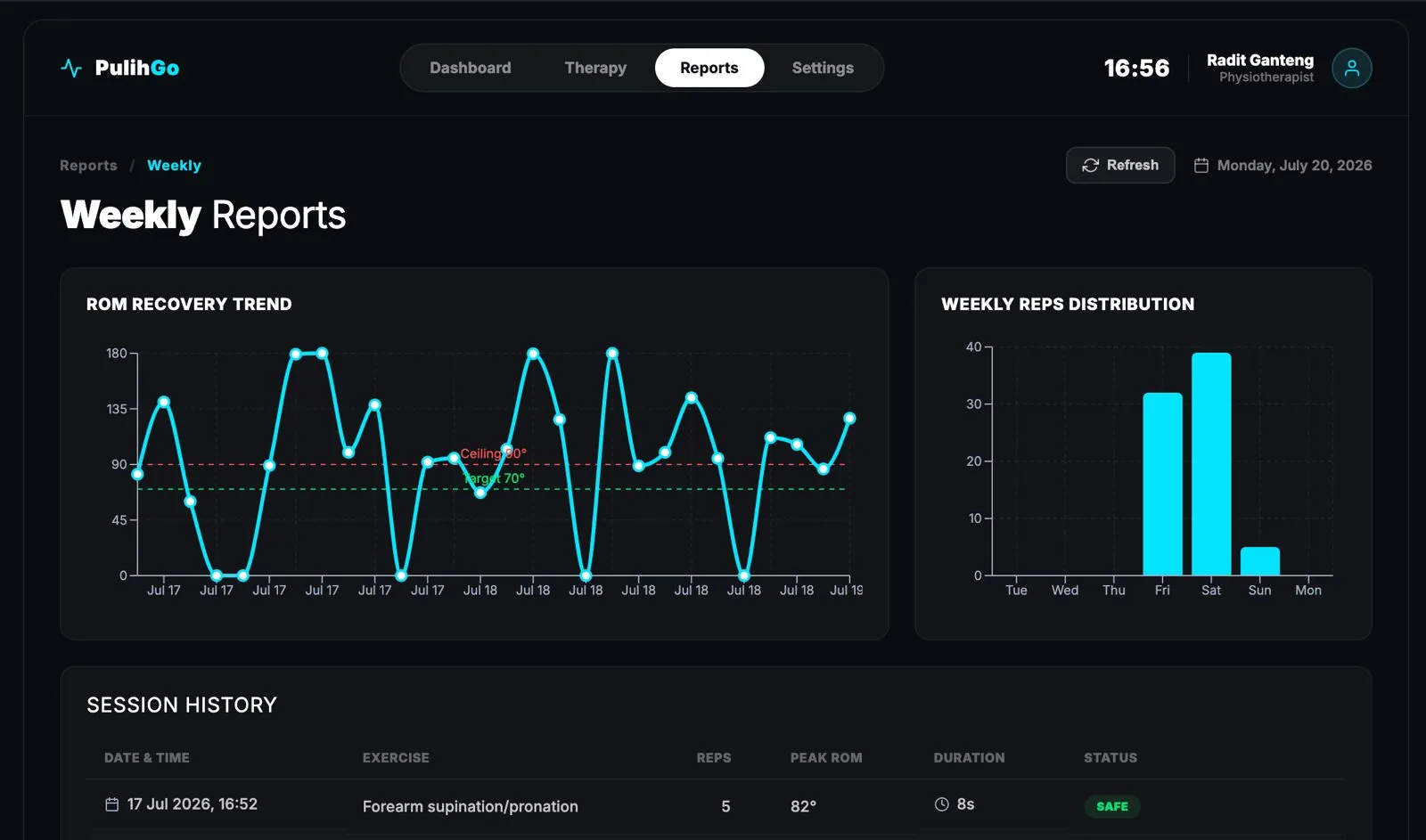
Gyroscope and accelerometer data sampled at about 50 Hz are fused into a calibrated forearm angle. The app segments repetitions and reports peak range of motion and a jerk-based smoothness score per rep, all computed in TypeScript on the phone with no ML. The therapist sets a target on a React and Vite dashboard; the phone reads that plan on launch, and finished sessions sync back through Supabase to a range-of-motion trend chart.
Safety & offline-first
A range-of-motion ceiling warns before the arm goes too far, and a one-tap "Stop, it hurts" button ends and flags the session, followed by a pain check on the Numeric Rating Scale. Every session is saved on the device before any network call, so a dead connection never stops a patient practising. PulihGo is a therapy-support aid: it does not diagnose or replace a therapist.
My role
I owned the frontend, local storage and safety systems in a team of four. I delivered the UI, the storage layer and the therapist progress dashboard within the 30-hour hackathon window.
Outcome
1st Place in the Health Track at Garuda Hacks 7.0, held on 16–18 July 2026. We demoed the full loop live: a prescription set on the dashboard, a measured session on the phone, and the result charted back for the therapist.